

 Aerospace & Defence
  Agriculture
  Automotive
  Building & Construction
  Chemicals
  Digital Technologies
  Energy & Power
  Equipment & Machinery
  FMCG
FMCG  Hospitality & Tourism
  Metallurgy
  Oil & Gas
  Retail Businesses
  Materials
  Banking & Financial Services
  Electronics & Semiconductors
  Healthcare & Pharmaceutical
  Packaging




Solar Vehicle Market Report Overview
According to Novatrends Market Intelligence, the solar vehicle market size is valued at USD 566.21 Million in 2024 and expected to register a growth rate of CAGR 24.40% during the forecast period (2025 – 2032). The solar vehicle market is an emerging segment of the electric vehicle (EV) industry, integrating photovoltaic (PV) panels to harness solar energy for propulsion or auxiliary power.
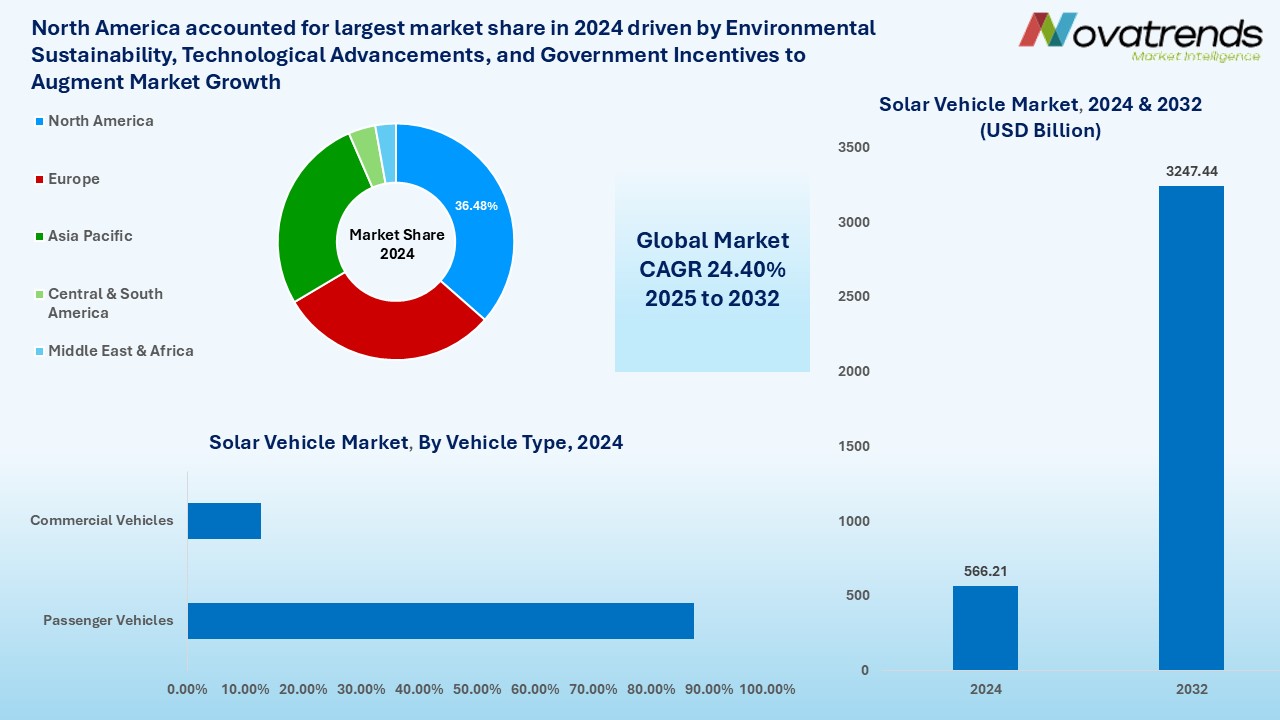
While still in its early stages, the global solar vehicle market is experiencing rapid growth, driven by the increasing demand for sustainable transportation, advancements in solar efficiency, improvement in battery technology and supportive regulatory frameworks.
Industry Snapshot
Market Drivers: Environmental Sustainability, Technological Advancements, and Government Incentives to Augment Market Growth
With transportation accounting for a substantial portion of carbon emissions worldwide, solar Vehicle offer a clean alternative that produces zero tailpipe emissions. Governments and organizations are increasingly committing to carbon neutrality goals, making sustainable mobility solutions more desirable. This shift in consumer and regulatory mindset supports the adoption of solar-powered Vehicle. For instance, Lightyear, a Dutch startup, launched the Lightyear 0, a solar car that can drive up to 388 miles with integrated solar panels that add up to 43.5 miles per day. This model exemplifies how solar energy can reduce dependency on traditional electric charging, lowering the environmental impact. Furthermore, improved photovoltaic (PV) efficiency and the integration of lightweight, high-performance materials make solar Vehicle more practical and commercially viable. These advancements are helping manufacturers overcome barriers such as limited range and energy storage capacity. A prime example is Aptera Motors, which developed a three-wheeled solar EV with a drag coefficient of just 0.13, enabling up to 1,000 miles of range with solar input providing up to 40 miles per day in optimal sunlight. This shows how cutting-edge technology can significantly extend range and reduce reliance on external charging.
Government policies and incentives play a crucial role in accelerating the adoption of solar Vehicle. Financial incentives such as tax rebates, grants, and subsidies for clean energy Vehicle reduce the initial cost burden on consumers, while regulatory measures like fuel economy standards and zero-emission vehicle mandates push manufacturers toward sustainable innovation. In Germany, for example, strong government support combined with automotive R&D capacity has made the country a leader in the European solar vehicle market. The availability of funding and policy backing makes it feasible for startups and established manufacturers alike to invest in solar vehicle development. Aforementioned factors are expected to propel market growth in near future.
Market Restraints: High Manufacturing Costs, Limited Driving Range & Output, and Weather Dependency & Geographical Limitations to Restrain Market Growth
Integrating photovoltaic solar panels, lightweight composite materials, and advanced battery systems increases production costs compared to conventional electric or internal combustion Vehicle. These costs make solar Vehicle less affordable for the average consumer and limit mass adoption. For instance, Sono Motors, a German startup that aimed to produce the Sion, a solar electric vehicle priced affordably for the masses. Despite securing over 20,000 preorders, the company filed for insolvency in 2023 due to escalating production costs and an inability to secure sufficient funding, highlighting how high manufacturing costs can hinder even promising ventures. Additionally, Solar Vehicle currently face performance limitations due to the constrained surface area available for solar panels on a car. This means the energy generated by onboard panels is often insufficient to fully power the vehicle over long distances without supplemental charging. The amount of power generated is only enough for short daily commutes in sunny regions, making the Vehicle less practical for all consumers. For instance, Squad Mobility's compact solar car, designed for urban use, can only gain 21 to 30 kilometers of range per day from solar charging, adequate for short city trips but not for intercity travel. This limitation restricts the broader appeal of solar Vehicle, especially in countries with limited sunlight or rural areas where daily travel distances are greater.
Also, the performance of solar Vehicle is highly dependent on geographic and climatic conditions. In regions with frequent cloud cover, rain, or snow, the solar input is drastically reduced, limiting the vehicle's efficiency and reliability. This makes solar Vehicle a less attractive option in many parts of the world, especially where sunlight is not consistent year-round. For instance, while Vehicle like the Lightyear 0 are well-suited for sunny regions like Southern Europe or California, their efficiency diminishes significantly in places like the UK or Northern Europe. This weather dependency reduces the universal viability of solar Vehicle and complicates efforts to scale them globally, which may restrain market growth during the forecast period.
Market Opportunities
Emerging technologies in solar energy, battery systems, and materials science offer immense potential to address current limitations of solar Vehicle. Innovations such as perovskite solar cells, which promise higher efficiency and flexibility than traditional silicon cells, and solid-state batteries, which are lighter, safer, and have higher energy density could drastically improve the range, safety, and overall performance of solar Vehicle. For instance, Lightyear shifted its focus from the high-end Lightyear 0 to a more affordable model, the Lightyear 2, which aims to combine affordability with technological advancements. This pivot is based on integrating more efficient and cost-effective components to make solar Vehicle accessible to the broader market. As technology becomes cheaper and more scalable, these innovations can unlock mass-market potential. Moreover, Solar Vehicle offer a unique opportunity to integrate with smart grid systems and participate in vehicle-to-grid (V2G) energy exchange. This means that solar Vehicle can not only draw energy from the grid when needed but also feed surplus solar energy back into the grid, essentially turning every vehicle into a mobile power plant. This dual capability enhances the overall utility of solar Vehicle and supports the broader renewable energy ecosystem. For instance, companies like Sono Motors explored integrating bidirectional charging and V2G capabilities in the Sion, aiming to make it a viable energy storage solution for homes and businesses. While Sono’s business model faced financial challenges, the concept of turning solar EVs into grid assets remains a promising frontier.
Developing countries, especially those with high solar irradiance, represent a largely untapped market for solar Vehicle. These regions often face rising fuel costs, underdeveloped electric charging infrastructure, and urban congestion—making solar Vehicle ideal for short-distance travel in cities. Countries in Africa, Southeast Asia, and Latin America could benefit significantly from affordable solar EVs that don’t rely on grid-based charging. For instance, Squad Mobility is targeting global urban centers with its ultra-compact, solar-powered city vehicle that can charge itself using sunlight. Priced starting at just Euro 6,250, it's designed to be affordable and functional in crowded, sun-rich regions. Expansion into these emerging markets presents a major growth opportunity for solar vehicle manufacturers, which may create lucrative opportunities for market players in coming years.
Segmental Overview
By Vehicle Type
By vehicle type market is classified into Passenger Vehicles and commercial vehicles. Passenger Vehicles currently represent the largest segment of the solar vehicle market. This dominance is primarily driven by rising environmental awareness among consumers, government incentives for electric mobility, and growing concerns about fuel prices. Solar-powered passenger cars are particularly attractive in sunny regions, where they can supplement traditional charging methods and reduce electricity costs. For example, the Lightyear 0, developed by Dutch company Lightyear, was one of the first long-range solar EVs tailored for personal use. It featured solar panels that could add up to 43.5 miles (70 km) of driving range per day under optimal sunlight conditions. Although production was eventually halted due to financial issues, the vehicle demonstrated the practicality and appeal of solar integration in private cars. This segment is expected to grow further as solar technologies become more cost-effective and efficient.
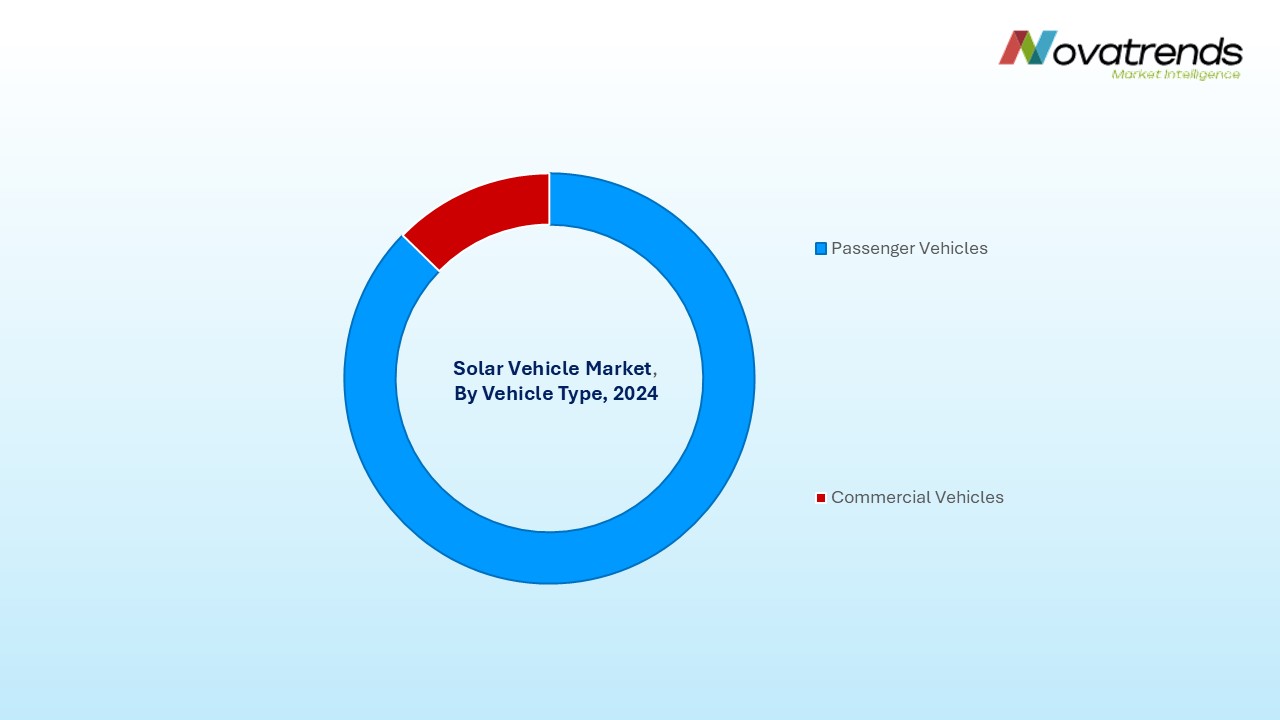
The commercial vehicles segment—comprising trucks, vans, and buses—is emerging as a strong growth area for solar Vehicle. The motivation here is largely operational: logistics and public transport operators are looking to reduce fuel expenses and comply with stricter emission norms. Solar energy can power auxiliary systems, extend battery life, or even reduce the frequency of charging stops. For instance, In India, in 2021, the government deployed 386 solar-powered buses as part of a green energy initiative for public transportation. These buses used solar panels to support the onboard systems, reducing reliance on the grid and lowering operational costs. While the solar contribution to vehicle propulsion is still limited, it significantly enhances energy efficiency and sustainability in high-usage commercial applications.
By Electric Vehicle Type
By electric vehicle type market is classified into Hybrid Electric Vehicle (HEVs), Battery Electric Vehicle (BEVs). Hybrid Electric Vehicle (HEVs) dominate the current solar vehicle market. These Vehicle combine internal combustion engines with electric propulsion systems, and the integration of solar panels enhances their efficiency by partially powering the battery or auxiliary systems. HEVs with solar roofs help extend fuel efficiency by reducing the load on conventional engines. For example, Toyota introduced the Prius PHV (Plug-in Hybrid), which comes with an optional solar roof that can power fans or even charge the battery under specific conditions. Likewise, Hyundai's Sonata Hybrid is equipped with a solar roof system that can charge the vehicle’s battery and add around 2 miles of range per day, helping reduce fuel consumption. This integration is appealing because it doesn’t require full reliance on solar power for propulsion, making it a practical and scalable solution.
Battery Electric Vehicle (BEVs) represent the fastest-growing segment in the solar vehicle market. BEVs rely entirely on battery power and do not use internal combustion engines. Solar panels in BEVs can significantly extend their range and reduce dependency on grid-based charging, especially in sunny climates. A prominent example is Aptera Motors, a U.S.-based startup that developed a futuristic three-wheeled solar BEV capable of driving up to 40 miles per day purely on solar energy and over 1,000 miles on a single full charge under optimal conditions. Another example is the Lightyear 0, which, despite production halts, showcased how integrated solar panels can meaningfully reduce charging frequency. This segment is expected to flourish as battery efficiency improves and solar integration becomes more advanced and affordable.
By Battery Type
By battery type market is classified into Lithium-ion batteries, Lead-acid batteries, and Others. Lithium-ion batteries are the most widely used battery type in solar Vehicle, primarily because of their high energy density, light weight, long life cycle, and fast charging capabilities. These characteristics make them ideal for electric Vehicle that rely on maximizing power-to-weight efficiency. Nearly all modern solar Vehicle, including advanced prototypes and commercially viable models, are built with lithium-ion battery systems. For instance, the Lightyear 0 used a lithium-ion battery pack to store solar energy captured by the vehicle’s body-integrated solar panels, helping it achieve an impressive real-world range. As battery costs decrease and energy density improves, the dominance of lithium-ion batteries in the solar vehicle segment is expected to grow even further. Lead-acid batteries represent an older and more traditional battery technology, known for their low cost and mature supply chains. However, they are heavier, have lower energy density, and shorter life cycles compared to lithium-ion batteries, which limits their adoption in advanced solar EVs. That said, they are still used in some low-speed electric or hybrid solar Vehicle, especially in developing countries where cost is a major constraint.
The “Others” category includes solid-state batteries, nickel-metal hydride (NiMH), and emerging chemistries that are still in the developmental or early commercialization phases. Solid-state batteries, in particular, hold significant promise for solar Vehicle due to their higher energy density, improved safety profile, and potential for faster charging. While not yet widely adopted in solar cars, companies like Toyota and QuantumScape are actively researching solid-state batteries for integration into future EVs. These could eventually be coupled with solar power systems to produce lightweight, long-range solar EVs. Nickel-metal hydride batteries, while historically used in early hybrids like the Toyota Prius, are becoming less common due to being outperformed by lithium-ion in most metrics. Nonetheless, the development of these newer battery technologies under the “others” umbrella is being closely watched as they may define the next leap in solar mobility innovation.
By Solar Panel Type
By solar panel type market is classified into Monocrystalline solar panels and Polycrystalline solar panels. Monocrystalline solar panels dominate the solar vehicle market because of their high energy efficiency, compact design, and excellent performance in low-light conditions. These panels are made from single-crystal silicon and offer better longevity and output per square meter, making them ideal for limited-surface applications like cars. For instance, the Lightyear 0 used integrated monocrystalline solar cells across the roof and hood to generate solar power, enabling up to 70 km (43 miles) of free driving per day in sunny regions. Their sleek design and efficiency make monocrystalline panels the preferred choice for most current and upcoming solar electric Vehicle despite their higher cost.
Polycrystalline solar panels, made from multiple silicon crystals melted together, are less efficient than monocrystalline panels but are more affordable and easier to manufacture. Due to their slightly lower efficiency and larger size requirements, they are less common in modern solar Vehicle but may still be found in cost-sensitive prototypes or experimental applications. In early concept Vehicle or low-speed solar-powered Vehicle like solar boats or campus transporters, polycrystalline panels may be used where space and performance demands are more flexible. However, the global shift toward higher-efficiency solutions is gradually phasing out their use in mainstream solar car development.
Regional Overview
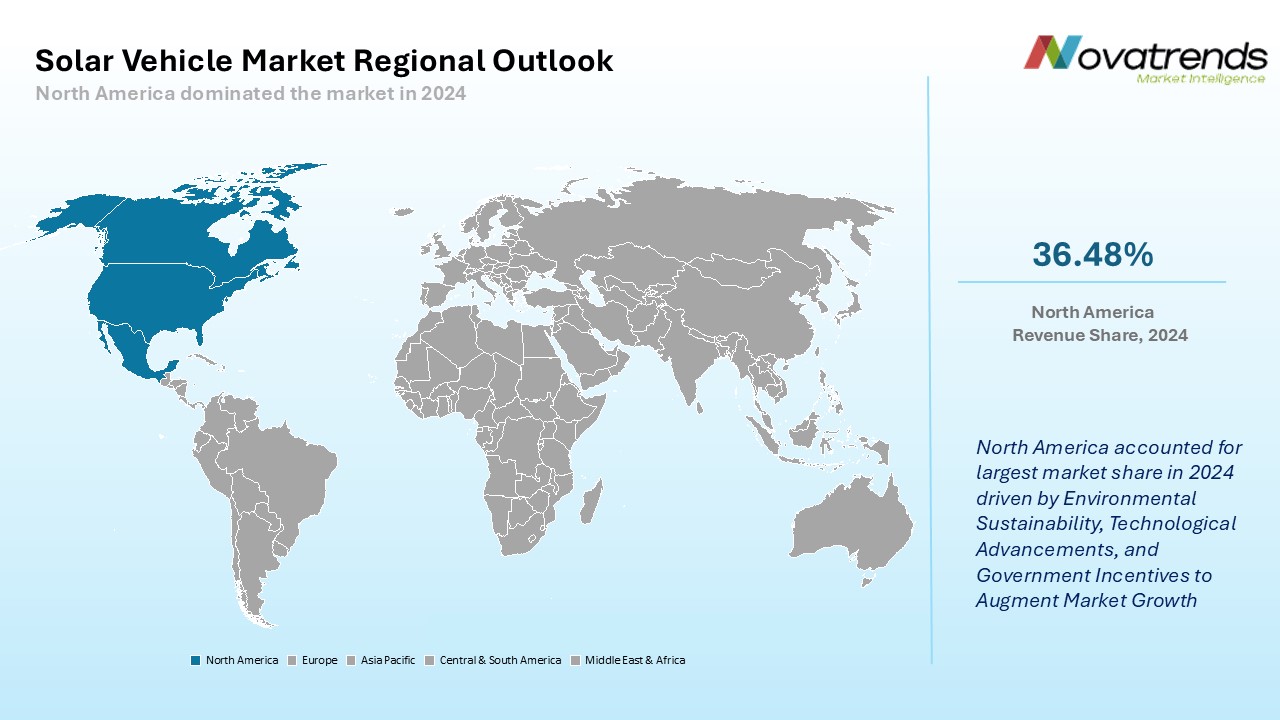
Region-wise the market is analyzed across North America, Europe, Asia-Pacific, Central & South America, and Middle East & Africa.
North America
North America, particularly the United States, is at the forefront of the solar vehicle market, driven by robust government incentives, technological advancements, and a growing emphasis on sustainable transportation. The region's commitment to reducing carbon emissions and promoting renewable energy sources has fostered an environment conducive to the adoption of solar-powered Vehicle. Companies like Aptera Motors are pioneering solar electric Vehicle (SEVs) that can harness solar energy to extend driving range, showcasing the potential of integrating solar technology into personal transportation. Additionally, the U.S. government's implementation of tariffs on Chinese electric Vehicle, batteries, and solar cells aims to bolster domestic manufacturing and reduce reliance on imports. However, challenges such as production inefficiencies and supply chain constraints have impacted companies like Phoenix Motor, highlighting the need for a robust local supply chain to support the growing demand for solar Vehicle.
Europe
Europe is experiencing significant growth in the solar vehicle market, propelled by stringent environmental regulations, ambitious climate goals, and a strong automotive industry. Germany leads the region, thanks to its robust automotive manufacturing base and technological expertise. Innovative companies like Lightyear have developed solar-powered Vehicle such as the Lightyear 0, which integrates solar panels to extend driving range. Although production of the Lightyear 0 was halted, the company is focusing on developing more affordable models like the Lightyear 2. Europe's commitment to renewable energy and sustainable transportation solutions, supported by policies like the EU's Net-Zero Industry Act, continues to drive the growth of the solar vehicle market.
Asia Pacific
The Asia-Pacific region is projected to be the fastest-growing solar vehicle market, fueled by urban pollution concerns, government initiatives, and a booming EV industry. Countries like China, Japan, South Korea, and India are investing in solar-electric vehicle integration to tackle air quality and reduce fossil fuel dependency. For instance, Toyota has tested solar-powered versions of the Prius in Japan, while India has introduced solar-assisted e-rickshaws and buses in various cities. China’s dominance in solar panel and battery manufacturing also gives it a strategic advantage in scaling solar EV production. High solar irradiance across much of the region makes solar a practical power supplement for Vehicle.
Central & South America
Latin America is in the early stages of solar vehicle adoption, but the region shows promising potential due to its abundant sunlight and increasing focus on sustainability. Countries like Brazil, Chile, and Argentina have seen a surge in solar panel installations and renewable energy policies, which could extend into the mobility sector. Although solar vehicle adoption is limited, pilot projects and solar-integrated electric buses such as Chile’s Santiago transit system, indicate the start of momentum. Cost remains a significant barrier, but the growing solar infrastructure could pave the way for future developments.
Middle East & Africa
The Middle East and Africa region has vast solar energy potential but is still a nascent market for solar Vehicle. That said, the region is increasingly exploring solar-powered mobility solutions due to extreme sunlight levels and growing sustainability agendas. The United Arab Emirates, for instance, is testing solar-assisted EV charging stations and has invested in pilot projects like solar racecars through university research programs. In Africa, solar-powered tuk-tuks and low-speed Vehicle are being piloted in Kenya and Rwanda, aimed at reducing fuel dependency in off-grid rural areas. These early-stage efforts could accelerate if costs come down and infrastructure improves.
Competitive Landscape
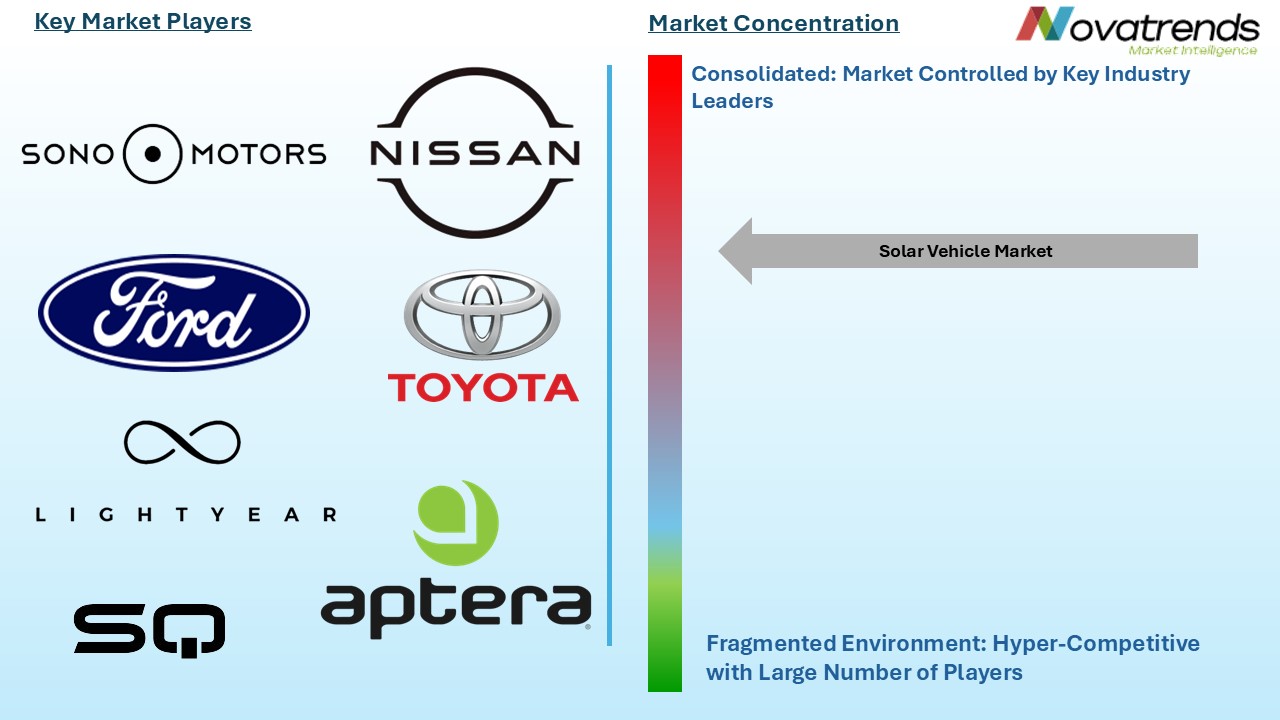
The solar vehicle market is still in its early stages, The solar vehicle market features a mix of established global automotive manufacturers and innovative startups, creating a dynamic and increasingly competitive environment. The market is currently somewhat consolidated, with large automakers leveraging their production scale and distribution networks, but competition is intensifying as new entrants introduce specialized solar technologies and business models.
Key Market Players
- Sono Motors GmbH
- Lightyear
- Nissan
- Mahindra & Mahindra Limited
- Ford Motor Company
- Volkswagen AG
- Daimler AG
- Tesla, Inc
- Cruise Car
- Aptera Motors Corp.
- Kandi America, Inc.
- Squad Mobility B.V.
- Toyota Motor Corporation
- VENTURI
Major Industry Updates
- In January 2025, Aptera introduced its production-ready solar electric vehicle (sEV) at CES 2025. The vehicle boasts up to 40 miles of solar-powered range per day and up to 1,000 miles on a single charge, emphasizing energy efficiency and minimal need for conventional charging.
- In January 2025, Sono Motors became the first company in Germany to receive national road approval (ABE) for its Solar Bus Kit, marking a significant milestone for vehicle-integrated photovoltaics in Europe.
- In March 2025, Toyota unveiled the FT-Me, a micro electric vehicle equipped with a solar roof capable of adding 20 to 30 km of range per day. The vehicle emphasizes energy efficiency and reduced carbon footprint.
- In May 2025, Clean Motion received an additional Euro 290,000 from the EU Horizon program to further develop its solar-charged Vehicle, as part of the SOLAR-MOVE consortium focusing on PV-integrated electric mobility applications.
- In January 2023, Dutch startup Lightyear announced the Lightyear 2, a solar-powered electric car priced at approximately USD 40,000. Production is slated to begin by the end of 2025, with the U.S., UK, and EU as initial markets.
- In March 2024, Aptera Motors, a California-based startup developing ultra-efficient solar electric Vehicle (EVs), announced that it had successfully raised $33 million in its latest funding round. The investment will be used to accelerate production of the company’s flagship model, the Aptera Sol, a three-wheeled solar EV designed for maximum energy efficiency.
- In May 2024, Dutch startup Squad Mobility has begun European deliveries of its innovative Squad Solar City Car, an ultra-compact, solar-powered electric vehicle priced at just Euro 6,500. Designed specifically for urban environments, the two-seater micro-car features integrated solar panels that supplement its battery range, making it ideal for short commutes and last-mile transportation.
Global Solar Vehicle Market Report- Scope (Customizable)
Scope |
Description |
|
Historic Period |
2018 – 2023 |
|
Base Year (Esti.) |
2024 |
|
Forecast Period (F) |
2025 - 2032 |
|
Market Revenue |
USD Million |
|
Market by Vehicle Type |
Passenger Vehicles and Commercial Vehicles |
|
Market by Electric Vehicle Type |
Hybrid Electric Vehicle (HEVs), Battery Electric Vehicle (BEVs) |
|
Market by Battery Type |
Lithium-ion batteries, Lead-acid batteries, and Others |
|
Market by Solar Panel Type |
Monocrystalline solar panels and Polycrystalline solar panels |
|
Market by Region |
North America, Europe, Asia-Pacific, Central & South America, and Middle East & Africa |
|
Countries Covered |
U.S., Canada, Mexico; Germany, UK, Italy, France, Spain, Russia; China, India, Japan, South Korea, Malaysia, Singapore, Thailand, Vietnam, Australia & New Zealand; Brazil, Argentina; Saudi Arabia, United Arab Emirates (UAE), Iran, South Africa |
 GET A FREE SAMPLE
 Need a custom report?